4.3.4. Oversubscription
The preceding 2-tier Fat-Tree examples (Figure 67, “2-Tier Fat Tree with 1:1 Subscription” and Figure 68, “2-Tier Fat Tree with 1:1 Subscription and Subdivided SuperNIC Links”) assume a non-blocking design with a 1:1 subscription ratio. Subscription is the ratio of the total bandwidth available below a network tier to the total bandwidth available above it. In a 1:1 design, the uplink bandwidth matches the endpoint-facing bandwidth, ensuring that traffic can move between tiers without oversubscription. In the examples shown, each leaf Switch provides 9.6 Tbps of bandwidth to connected SuperNICs and 9.6 Tbps of uplink bandwidth to the spine layer. Because these values are equal, the fabric has a 1:1 subscription ratio and is considered non-blocking.
When the aggregate endpoint bandwidth exceeds the available uplink bandwidth, the subscription ratio becomes greater than 1:1, creating an oversubscribed fabric. In this configuration, the network cannot simultaneously support all endpoints transmitting at full bandwidth across the fabric. As a result, congestion may occur when traffic demand exceeds the capacity of the uplinks. Although many subscription ratios are theoretically possible, practical designs are often influenced by Switch port counts and the goal of efficiently utilizing available hardware.
Consequently, oversubscription ratios are frequently implemented using simple integer values such as 2:1 or 3:1. Consider a 2:1 oversubscribed 2-tier Fat Tree using only native 400 Gbps connections. In this configuration, each leaf Switch uses 32 ports for endpoint connections and 16 ports for uplinks to the spine layer. Because all ports operate at the same bandwidth, the endpoint-facing bandwidth is twice the uplink bandwidth, resulting in a 2:1 subscription ratio. This design increases the number of supported endpoints compared to a non-blocking configuration. A non-blocking leaf supports 24 endpoints, whereas a 2:1 oversubscribed leaf supports 32 endpoints—an increase of approximately 33%. At fabric scale, this allows support for up to 1,536 endpoints using native connections. If endpoint links are subdivided into 200 Gbps connections, the maximum endpoint count doubles to 3,072 endpoints.
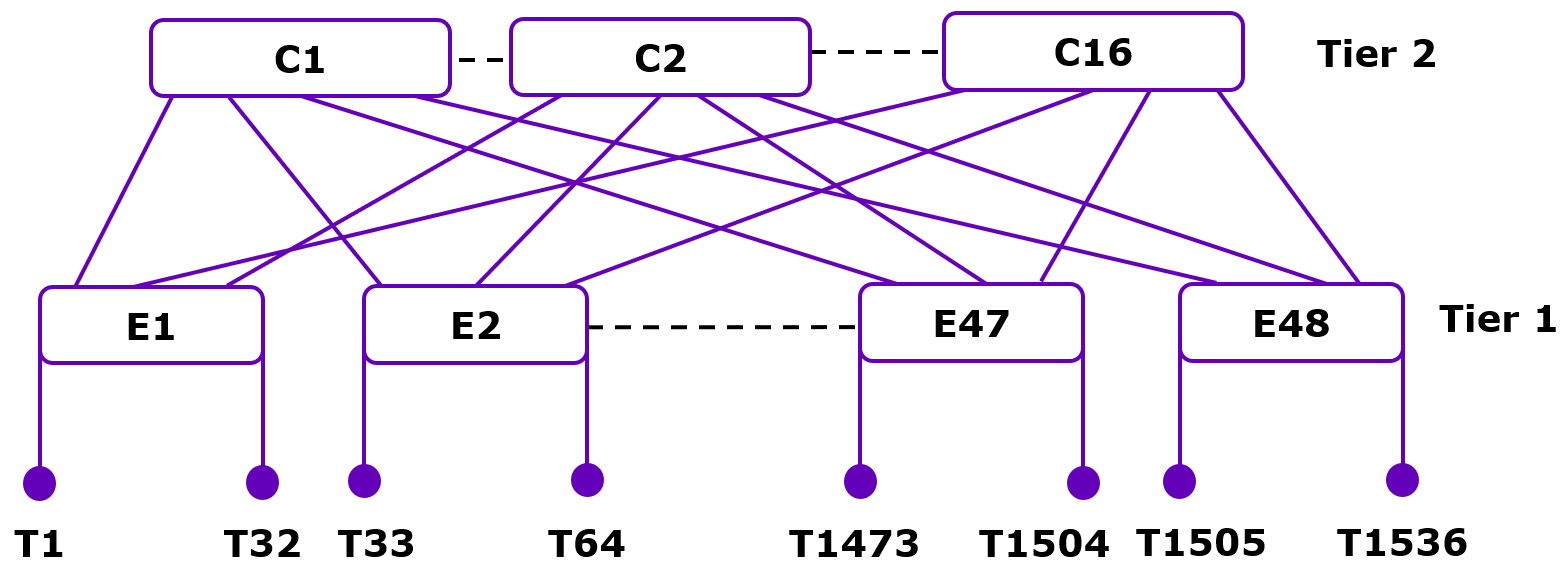
While oversubscription introduces the potential for congestion, the impact on application performance depends heavily on communication patterns. Many workloads exhibit strong communication locality, with large volumes of traffic exchanged between nearby endpoints or between endpoints connected to the same leaf Switch. Traffic that remains within a leaf Switch does not consume spine-layer bandwidth and therefore does not contribute to uplink congestion.
In these environments, a 2:1 oversubscription ratio may have little or no measurable impact on application performance while significantly increasing endpoint density and reducing infrastructure cost per endpoint. However, oversubscription can become problematic for workloads that generate substantial traffic between endpoints across the fabric. Applications that rely heavily on global communication patterns, such as MPI collective operations, can place significant demands on the spine layer. When multiple endpoints simultaneously compete for limited uplink bandwidth, traffic may queue at the leaf Switches, increasing latency and reducing effective throughput. These effects can be particularly detrimental to latency-sensitive applications, where small communication delays can propagate through the application and impair overall performance.
The decision to deploy an oversubscribed fabric therefore requires careful evaluation of workload characteristics, performance objectives, and budget constraints. Non-blocking fabrics provide the highest and most predictable performance but require more network infrastructure. Oversubscribed fabrics increase endpoint density and reduce cost, but they rely on the assumption that application traffic patterns will not continuously saturate the available uplink bandwidth. In practice, many deployments adopt a moderate level of oversubscription to balance performance, scalability, and cost.